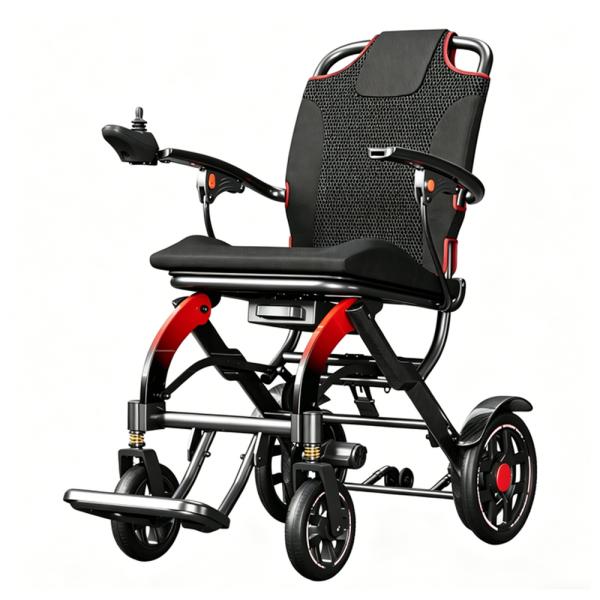
From "Transport" to "Freedom": How a Good Wheelchair Truly Changes Lives

I. A Need That Is Being Seen
II. The Core of Choosing a Wheelchair: Safety Above All Else
III. Lightweighting: From "Heavy and Clumsy" to "One‑Hand Lift"
IV. Avoiding Misconceptions: Don't Be Fooled by "Premium" Marketing
V. Daily Use: Safety Lies in the Details
What is a wheelchair? In many people's eyes, it is a chair with wheels. But for the more than 10 million people in China who rely on wheelchairs for mobility, it is a fundamental right to step back into the sunshine, back into the crowd, and back into life.
I. A Need That Is Being Seen
The global wheelchair market is growing at more than 5% annually. In 2025, the global wheelchair market was valued at approximately $5.97 billion and is projected to reach $9.56 billion by 2034. In China alone, the electric wheelchair market reached approximately ¥20.54 billion in 2025.
Behind this growth lie real and urgent personal needs: elderly people need a safe wheelchair to get out and enjoy the sunshine; young people with spinal cord injuries need an electric wheelchair to go to work, meet friends, and restart their lives; post‑surgery rehabilitation patients need a temporary auxiliary wheelchair to carry out daily activities.
The true driving force behind the growth of the wheelchair market is not a cold number, but every single person who longs to "get out and about."
II. The Core of Choosing a Wheelchair: Safety Above All Else
Precisely because a wheelchair carries an entire life, the choice must be made with extreme care.
Electromagnetic brakes – a baseline, not an option.
The 2026 national standard explicitly lists braking performance as a mandatory test item. Electromagnetic brakes automatically lock the wheels when the joystick is released and keep the wheelchair secure even if power is cut. Many low‑cost electric wheelchairs on the market eliminate electromagnetic brakes to cut costs. While such wheelchairs may work on flat ground, the risk rises sharply once they encounter a slope. Electromagnetic brakes are the core guarantee for safe travel – not a dispensable "premium feature".
Anti‑tip wheels – a critical detail often overlooked.
A wheelchair without anti‑tip wheels is not a mobility aid – it is a mobile safety hazard. This feature should be a non‑negotiable requirement when making a selection.
Size – more important than you think.
Many people assume a wheelchair is just "a chair on wheels," but it is actually more tailored than a pair of jeans. Choosing the wrong size can lead to back pain at best and pressure sores at worst. If the seat is too narrow, getting in and out is difficult and the hips and thighs are compressed. If the seat is too wide, the user cannot sit steadily, maneuverability is compromised, and the arms become fatigued.
The most responsible approach is to have a professional assess the user's physical function and dimensions and recommend a wheelchair that fits properly.
III. Lightweighting: From "Heavy and Clumsy" to "One‑Hand Lift"
Breakthroughs in materials science are transforming the wheelchair experience. Carbon fiber is redefining the lightweight standard for wheelchairs. Traditional steel wheelchairs often weigh over 15 kg, aluminum frames reduce that to 12–18 kg, and carbon fiber electric wheelchairs have now broken the 10 kg barrier, with some ultra‑light models weighing only 9.2 kg. This lightweight revolution is changing the way elderly people think about how far they can go.
What does lightweight mean in practice? It means caregivers can lift it with one hand; it means it can be easily placed into a car trunk; and it means elderly users can venture further on their own, without needing the whole family to help.
IV. Avoiding Misconceptions: Don't Be Fooled by "Premium" Marketing
Misconception 1: The more expensive, the better. A wheelchair is not about the highest price or the most features – it is about what fits best. Some high‑priced wheelchairs boast "fully intelligent automation," but for users with limited hand mobility, complex control buttons can actually become a burden.
Misconception 2: The lighter, the better. While lightness is important, stability is even more critical. For long‑term users, comfort and safety should always come first.
Misconception 3: The more features, the better. The choice of a wheelchair should be based on the user's specific condition, environment, and goals. Prioritize core needs like stability and ease of control, rather than chasing flashy, unnecessary functions.
V. Daily Use: Safety Lies in the Details
A good wheelchair needs proper use and maintenance once it arrives home.
-
Getting on and off – Always engage the brakes, fold up the footrests, and only move after making sure you are steady. Never stand on the footrests, as this may cause the wheelchair to tip over.
-
Overcoming obstacles – For thresholds or bumps, slightly lift the front wheels to pass through; for electric wheelchairs, slow down and proceed carefully.
-
Routine maintenance – Keep the wheelchair clean by wiping it regularly; lubricate the wheel axles and brakes monthly; and periodically inspect tires, brakes, and other key components.
-
Special care for electric wheelchairs – Keep the motor area dry and do not rinse it with water; regularly check that the controller plugs are secure.
Before each use, check that all screws on the front wheels, rear wheels, and parking brakes are tight, and tighten any loose ones promptly.
A wheelchair can be a person's entire world. It can also be a window through which they see the world again.
Choosing the right wheelchair is choosing a more dignified and freer way of life. It is not the end of the story – it is the beginning of a new chapter.
Related Products

Steel Rollator
GM30014
Aluminium Rollator Walker
GM30022
Cerebral Palsy wheelchair
GM10025