
Shear Forming
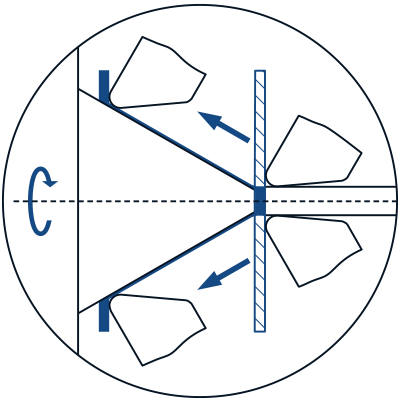
Shear spinning, also known as forced spinning of conical components, involves mounting and securing a sheet or conical blank onto a die. During spinning, the spinning roller, along with the workpiece and die, rotates, causing the workpiece to deform incrementally. This process allows the blank to achieve the desired wall thickness and angle. Shear spinning is further categorized into two types: forward spinning and reverse spinning.
In shear spinning, the wall thickness of conical or other uniquely shaped parts adheres to the Law of Sines. The process typically involves single or double roller passes, deliberately reducing wall thickness without altering the diameter. Discussions on forming load and accuracy across different stages of the process have been conducted, leading to the development of an optimal forming scheme based on analytical insights.