
Flow Forming
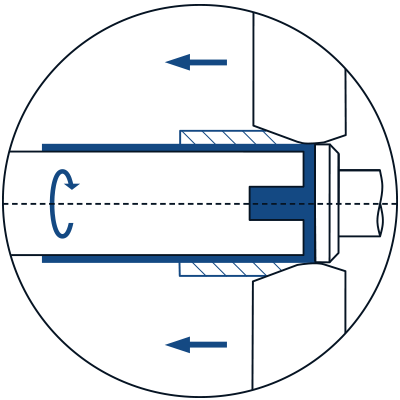
Multi-Rollers technology: cylindrical deformation thinning spinning is a process for manufacturing thin-walled, elongated cylindrical components. This method involves spinning rollers pressing against a tube blank. The tube blank rotates in sync with the mandrel and moves along its axis. This spinning technique adheres to the principle of constant metal volume. Depending on the movement direction, it can be categorized into two types of spinning: forward spinning, where the material flow direction aligns with the roller, and reverse spinning, where the material flow is opposite to the roller's direction.
Regarding the deformation mechanism and part shapes, strong spinning is classified into two types: cylindrical part spinning (flow spinning) and conical part spinning (shear spinning). Flow spinning is primarily used for creating high-precision, elongated cylindrical components. In contrast, shear spinning is more suited for shaping conical components.
This version aims to maintain the original technical details while improving readability and clarity.