
Fan and Air Condition
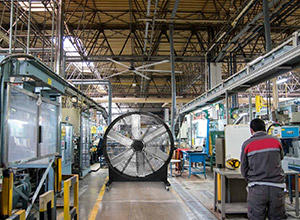
Fans, Blowers & Related Heating Systems Parts, Ventilation System Parts, Air Conditioning Parts, Cones, Shrouds, Fans, Blowers, Housings, Hoods, Vents, Covers, Guards, Flanges, Bellmouths, End Caps, Dampers, Couplers, Reducers.
The spinning process is a technique that employs one or more rollers to compress a metal blank (such as a circular plate, seamless or welded tube, or cone blank) while it rotates. This process applies a unit pressure of 25-35 MPa, inducing gradual plastic deformation in the metal and ultimately achieving the desired shape and size for hollow, thin-walled, rotary body parts. The spinning process encompasses various forming techniques, including extrusion, drawing, rolling, and bending.
Regarding the formation of ventilation parts, the process offers four main advantages:
1. Simplified tooling: Typically, only a basic mold is required. The materials for the mold are affordable, often comprising standard cast iron or sheet material welded together. The simplicity of the process translates into lower costs. (In contrast, stamping and drawing processes necessitate at least one set of die steel, and sometimes multiple sets of concave and convex dies.)
2. Enhanced mechanical strength: Post-spinning, the material's mechanical strength is notably improved. This allows for thinner wall thickness in the parts, leading to material savings.
3. Seamless, aesthetically pleasing parts: The spinning process yields integral parts without the need for welding, resulting in a more attractive finish.
4. Efficient and cost-effective equipment: Spinning equipment is lightweight and energy-efficient, yet capable of processing large parts, offering excellent cost-effectiveness.